This page was made because of all the differing spark plug choices that end up getting posted whenever this question comes up.
Rather than having people waste our time arguing over which spark plugs people should be using, we should instead be focused on testing the spark plugs available to us. This way we as a community can determine what plugs are best and then spread that knowledge to the rest of the internet.
One of the reasons I built this page was to help us gather proper, applicable testing data. The hope is that this testing will provide definitive data and make it easier for people to choose the correct spark plug for their needs.
Spark Plugs Being Tested
The two main spark plugs that I’ve selected for testing are the NGK 5960 (ZFR6T-11G) and NGK 4435 (ZFR5E-11).
I’ve chosen the 5960 (ZFR6T-11G) because it is considered by NGK to be an OE equivalent plug for the 2.5L. This means that it should be a good plug for completely stock vehicles. Another reason for choosing this spark plug is that it is one of the more popular spark plugs available for the 07K. The 5960 features a copper core with a standard cut nickel electrode. Lifespan is approximately 30k miles according to NGK.
I’ve chosen the 4435 (ZFR5E-11) because they are a higher temperature range, V-Power spark plug. NGK markets the V-Power spark plug as a performance oriented solution. The 4435 uses a copper core with NGKs V-cut electrode for a more dispersed spark pattern. Lifespan is approximately 30k miles according to NGK.
Hot vs Cold(er)
Essentially the two major differences between these spark plugs are the heat range (5960 being a 6 and the 4435 being a 5), and the electrode style (5960 is standard and the 4435 is V-cut). Typically a colder spark plug will offer the possibility of more timing advance, while a hotter plug will offer better carbon cleaning capabilities. However, when selecting a performance spark plug, you want to choose a heat range that allows for the fastest timing while also getting hot enough to keep the plug clean and unfouled.
The 4435 also incorporates NGK’s the V-cut electrode, which should also offer a more performance oriented spark as well. While the main focus of this testing is to find which heat range is more effective, it should also show whether the V-cut electrode makes a big enough difference for performance oriented vehicles.
If the 5960 tests well against the 4435 plug, I will also consider testing a 6 heat range NGK V-Power spark plug (4291/ZFR6F-11). Essentially, the results I gather from testing these two spark plugs will determine if I end up testing that plug. This plug would basically combine the colder heat range of the 5960s with the V-Power electrode.
Testing Methodology
Since testing brand new spark plugs would only tell part of the story, I am performing my testing at different mileages. I did this because performance oriented cars with ECU tuning tend to run rich. One of the reasons to use hotter spark plugs in a N/A engine is the increased carbon burning potential. If we were to simply test a brand new set of plugs, this wouldn’t give us any insight related to higher mileage use. Obviously for the long term wear it’s going to take a little before we see some proper testing data for some of these plugs, but getting to 10k shouldn’t take too long.
- New – under 1,000 miles on plugs
- Intermediate wear – approximately 10k miles on plugs
- Long-term wear – approximately 20k miles on plugs
Highway Cruise
This test is to measure how efficiently the engine is running while cruising on the highway. This tests the plugs ability to provide a clean combustion cycle that will benefit fuel economy.
Testing is very easy: on a flat stretch of highway, accelerate to 80 MPH, turn on cruise control, count down three seconds and start the log. I typically only run this log for about 1/4 of a mile or 8-10 seconds. It’s very important to make sure that you’re testing this on a flat, level section of road.
0-60 MPH Hard Dig Pull
This test is performance oriented and is aimed at those that enjoy street light racing. The test is super simple: start the log at 0 MPH and mash the throttle until you hit 60 MPH. That’s it.
30-100 Hard Roll Pull
Once again, this is another performance oriented test. This time testing is meant to show ignition changes under a full engine load. Simply put the car into 3rd gear, take it to 30 MPH, start your log and floor the throttle pedal until you hit 100 MPH.
VCDS (VAG-COM) Logging:
- 001-1 Engine Speed
- 003-4 Ignition Timing
- 020-1 Cylinder Ignition Angle Delay (cyl 1)
- 020-2 Cylinder Ignition Angle Delay (cyl 2)
- 020-3 Cylinder Ignition Angle Delay (cyl 3)
- 020-4 Cylinder Ignition Angle Delay (cyl 4)
- 020-5 Cylinder Ignition Angle Delay (cyl 5)
- 031-1 Lambda, Current Value
- 031-2 Lambda, Specified Value
- 054-3 Accelerator Pedal Position
- 112-4 Median Exhaust Temp
- 114-1 Engine Load (specified)
- 114-3 Engine Load (actual)
If you’re interested in contributing your own logs, it’s pretty easy to do via VCDS. Make sure you enable the turbo mode to ensure that you get the correct data quality. If you’re having any issues setting up the logging, send me an email and I’ll help you out.
Don’t Forget Your Coilpacks!
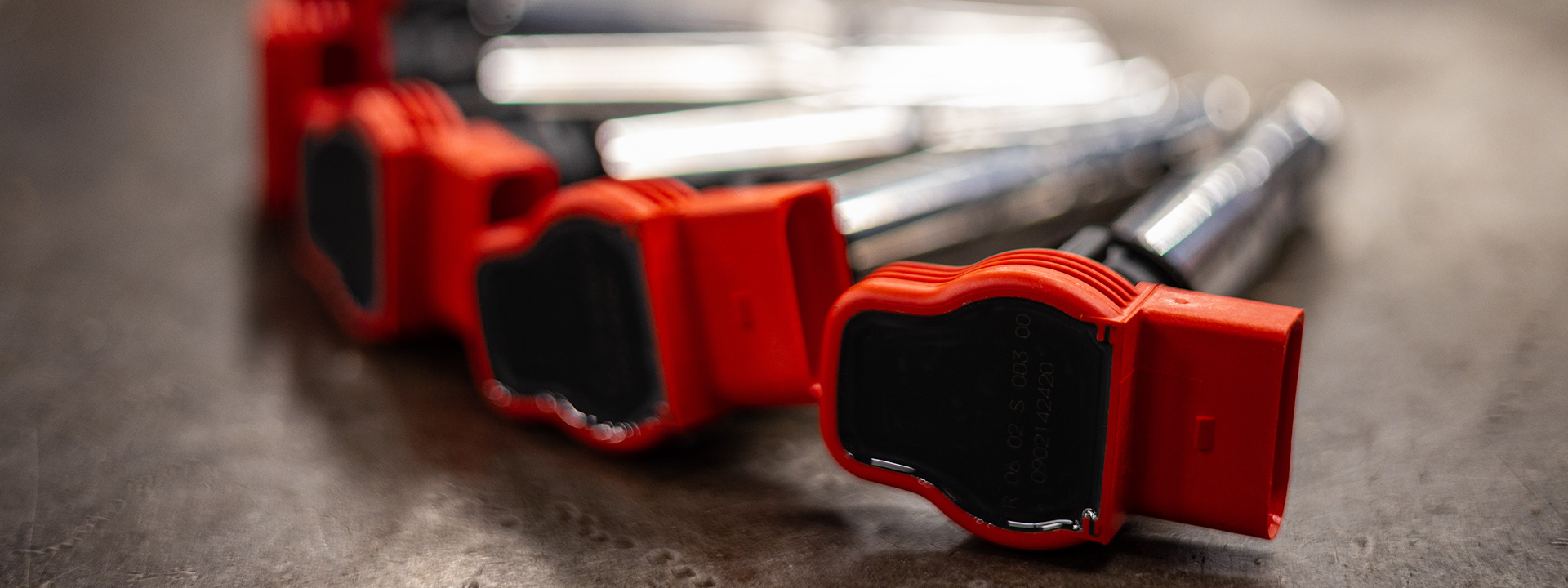
Please remember that your spark plugs are only half of the ignition system in your engine. The other half of the system are the ignition coilpacks that provide power to the spark plugs. We’ve found that these typically last around 60-80k miles (depending on your driving style) before needing replacement.
Whether you prefer standard replacement coilpacks, red “R8” style coilpacks or APR aftermarket coilpacks, NGP has you covered. We conveniently keep all of these different coilpacks in stock so you have options available when the time comes to replace them.
Click or tap here to browse our selection of 2.5L coilpacks and ignition service kits.
Turbocharged 2.5L 07K?
You’ve probably noticed that the above information is oriented towards N/A spark plugs. Even if you have a turbocharged 2.5L 07K, please feel free to share your spark plug findings with me. I’m very interested in seeing that information as well.